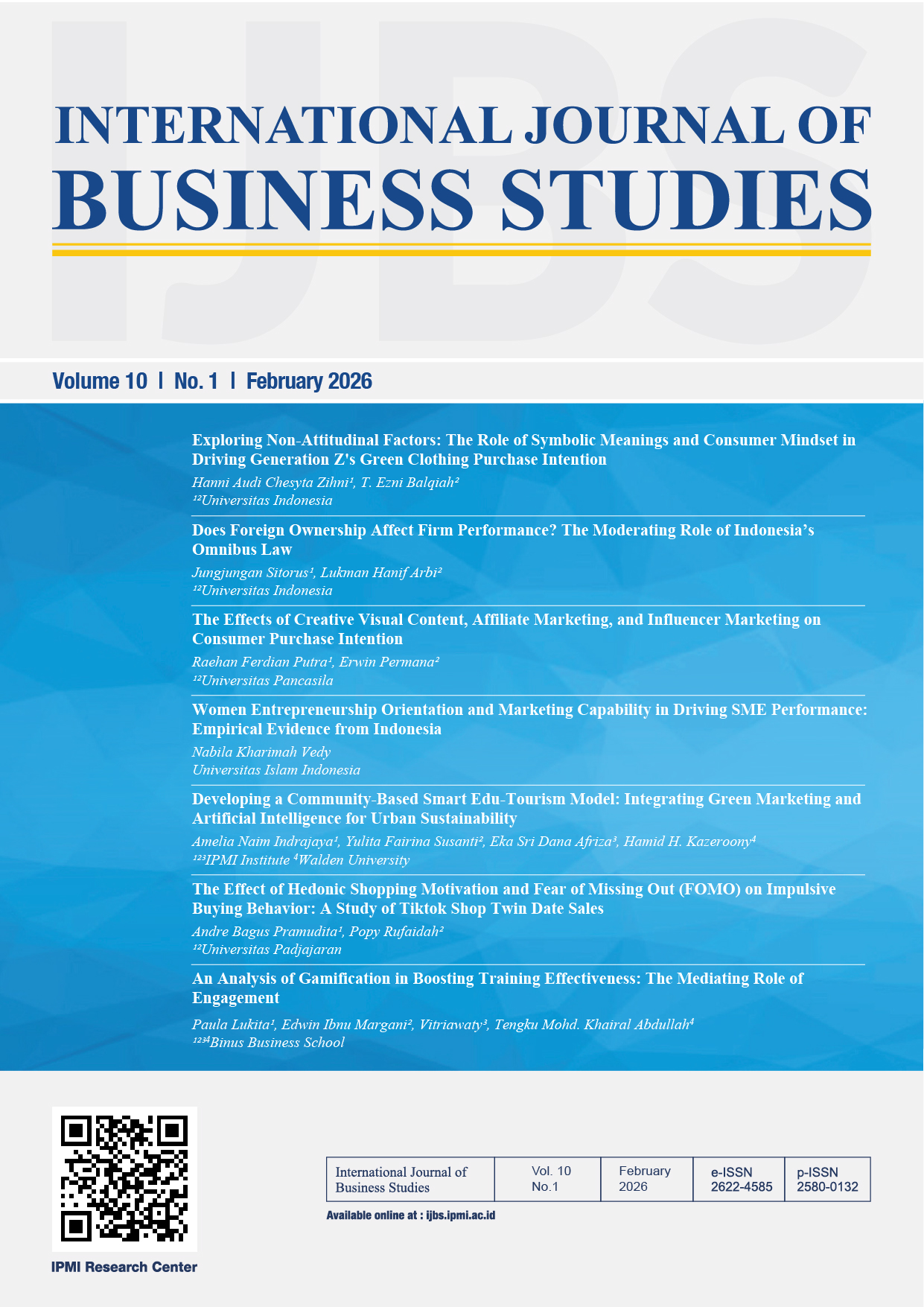
An Analysis of Gamification in Boosting Training Effectiveness: The Mediating Role of Engagement
DOI:
https://doi.org/10.32924/ijbs.v10i1.421Keywords:
Gamification, Employee Performance, Motivation, Training and Development, Work Experience., employee engagementAbstract
This study explores how gamification influences the effectiveness of training in a corporate middle management program. Based on Social Cognitive Theory (SCT), it aims to fill the mechanistic gap by proposing and empirically testing a mediation model to understand how gamification works, focusing on whether its impact is mediated through participant engagement. The study used a quantitative, explanatory survey design. Data was gathered from 214 participants in the "Leading and Empowering Your Team" module, a key part of the Astra Middle Management Program (AMMP). The proposed mediation model was evaluated using Partial Least Squares Structural Equation Modeling (PLS-SEM) with SmartPLS 4. The model exhibited excellent predictive accuracy, accounting for 68.6% of the variance in Training Effectiveness and 56.4% in Engagement. Path analysis verified that all hypothesized relationships were strong and statistically significant. Gamification had a significant impact on training effectiveness ( β = 0.599, p < 0.001). Additionally, a notable indirect effect was observed (β = 0.209, p = 0.006), indicating that Engagement mediates this relationship (β for GAM -> ENG = 0.751; β for ENG -> TEF = 0.278). This study offers solid empirical evidence for the two main ways gamification functions. It shows that gamification is not merely a gimmick for "fun" (engagement), but also serves as a strong cognitive instrument that enhances learning directly. The research highlights Engagement as a crucial mechanism, providing T&D practitioners with a clearer understanding of how their gamified strategies accomplish their goals.
Downloads
Submitted
Accepted
Published
How to Cite
Issue
Section
License
Copyright (c) 2026 Paula Lukita, Edwin Ibnu Margani, Vitriawaty, Tengku Mohd. Khairal Abdullah

This work is licensed under a Creative Commons Attribution 4.0 International License.

International Journal of Business Studies by Sekolah Tinggi Manajemen IPMI is licensed under a Creative Commons Attribution-ShareAlike 4.0 International License.
Authors who publish with this journal agree to the following terms:
1. Copyright Transfer Agreement Form can be downloaded HERE.
2. Authors retain copyright and grant the journal right of first publication with the work simultaneously licensed under a CC BY-SA Creative Commons Attribution-ShareAlike 4.0 International License that allows others to share the work with an acknowledgement of the work's authorship and initial publication in this journal.
3. Authors are able to enter into separate, additional contractual arrangements for the non-exclusive distribution of the journal's published version of the work (e.g., post it to an institutional repository or publish it in a book), with an acknowledgement of its initial publication in this journal.
4. Authors are permitted and encouraged to post their work online (e.g., in institutional repositories or on their website) prior to and during the submission process, as it can lead to productive exchanges, as well as earlier and greater citation of published work.

















 This work is licensed under a