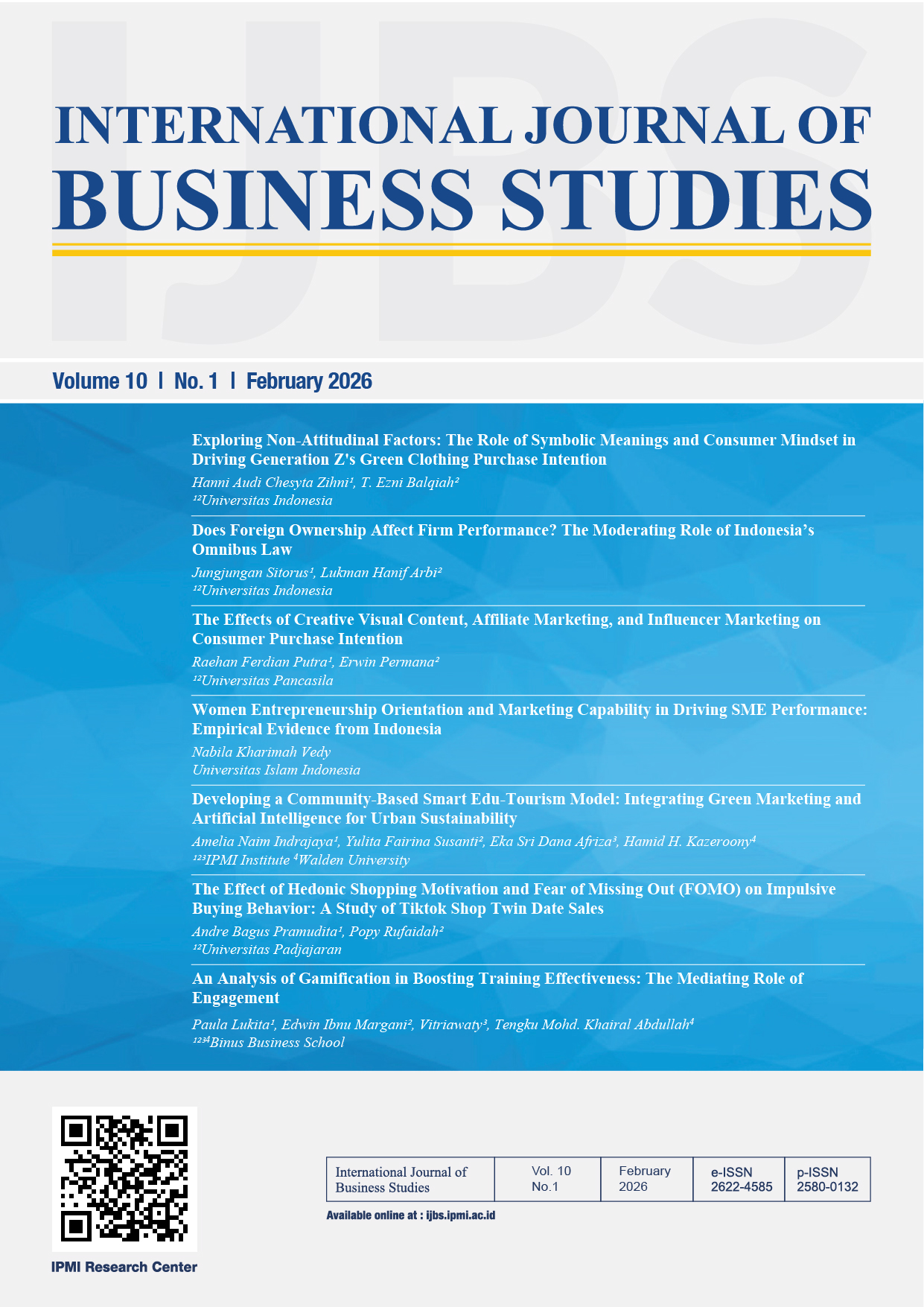
The Effect of Hedonic Shopping Motivation and Fear of Missing Out (FOMO) on Impulsive Buying Behavior: A Study of Tiktok Shop Twin Date Sales
DOI:
https://doi.org/10.32924/ijbs.v10i1.415Keywords:
Fear of Missing Out, Hedonic Shopping Motivation, Impulsive Buying, E-CommerceAbstract
This study explores how hedonic shopping motivation and fear of missing out influence impulsive buying during the Twin Date TikTok Shop event in Indonesia. Using the adapted dimensions of hedonic shopping motivation and fear of missing out (FOMO), this study examines the behavior of TikTok Shop consumers in Indonesia upon encountering this promotional event. The primary objective is to examine and analyze consumer hedonic shopping motivation and fear of missing out and their impact on impulsive buying during the Twin Date TikTok Shop Indonesia promotion, using a set of indicators adapted from previous research. Data were collected through a survey administered to 114 TikTok Shop consumers participating in the Twin Date event. This study used Partial Least Squares Structural Equation Modeling (PLS-SEM). The results show that fear of missing out significantly influences impulsive buying, while hedonic shopping motivation influences the effect, albeit in the opposite direction. However, a limitation of this study is its focus solely on hedonic shopping motivation and fear of missing out on impulsive buying. This study ignores other potential influencing variables, such as price, product quality, and consumer preferences. Therefore, this study shows that Hedonic Shopping Motivation and FOMO contribute to Impulsive Buying during the Twin Date event on TikTok Shop in Indonesia.
Downloads
Submitted
Accepted
Published
How to Cite
Issue
Section
License
Copyright (c) 2026 Andre Bagus Pramudita, Popy Rufaidah

This work is licensed under a Creative Commons Attribution 4.0 International License.

International Journal of Business Studies by Sekolah Tinggi Manajemen IPMI is licensed under a Creative Commons Attribution-ShareAlike 4.0 International License.
Authors who publish with this journal agree to the following terms:
1. Copyright Transfer Agreement Form can be downloaded HERE.
2. Authors retain copyright and grant the journal right of first publication with the work simultaneously licensed under a CC BY-SA Creative Commons Attribution-ShareAlike 4.0 International License that allows others to share the work with an acknowledgement of the work's authorship and initial publication in this journal.
3. Authors are able to enter into separate, additional contractual arrangements for the non-exclusive distribution of the journal's published version of the work (e.g., post it to an institutional repository or publish it in a book), with an acknowledgement of its initial publication in this journal.
4. Authors are permitted and encouraged to post their work online (e.g., in institutional repositories or on their website) prior to and during the submission process, as it can lead to productive exchanges, as well as earlier and greater citation of published work.












 This work is licensed under a