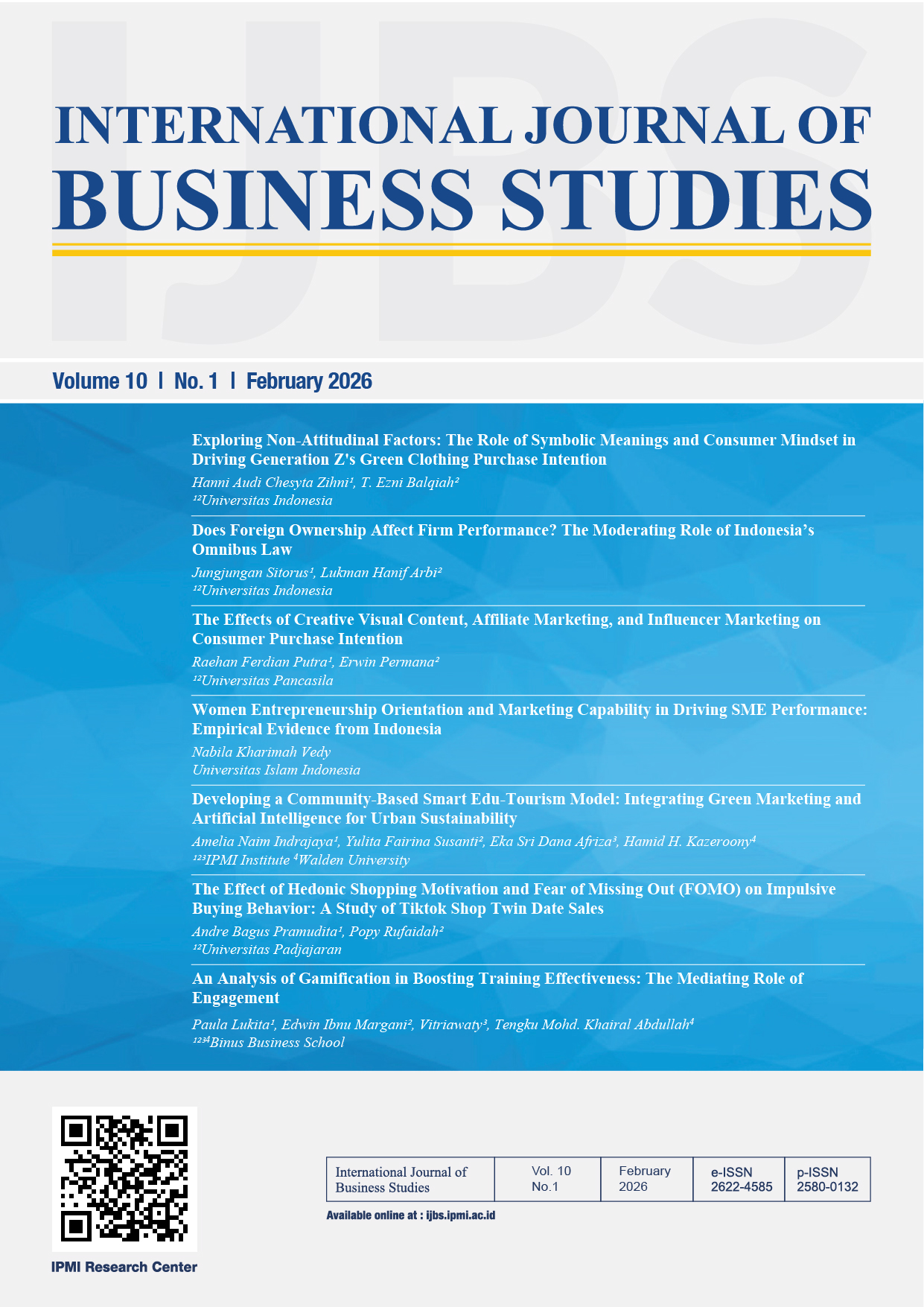
Exploring Non-Attitudinal Factors: The Role of Symbolic Meanings and Consumer Mindset in Driving Generation Z's Green Clothing Purchase Intention
DOI:
https://doi.org/10.32924/ijbs.v10i1.406Abstract
This study examined the determinants of green clothing purchase intention among Indonesian Generation Z by integrating the Theory of Planned Behavior with symbolic meanings and consumer mindset. Data were collected from 384 respondents through an online survey and analyzed using Partial Least Squares Structural Equation Modeling. The results indicated that all dimensions of symbolic meanings, including environmentalism symbol, status symbol, innovation symbol, and fashion symbol, positively and significantly influenced attitude toward green clothing purchasing behavior. Environmentalism symbol showed the strongest effect on attitude. Attitude emerged as the most influential predictor of purchase intention, followed by subjective norm, while perceived behavioral control did not exhibit a significant effect. Mediation analysis confirmed that attitude partially mediated the relationships between symbolic meanings and purchase intention. In addition, moderation analysis demonstrated that consumer mindset significantly strengthened the influence of symbolic meanings on attitude, with stronger effects observed among consumers with a fixed mindset. Overall, the findings suggested that green clothing purchase intention among Generation Z was driven by a combination of symbolic interpretations, attitudinal evaluation, and cognitive orientation, highlighting the importance of symbolic and psychological factors in sustainable fashion consumption.
Downloads
Submitted
Accepted
Published
How to Cite
Issue
Section
License
Copyright (c) 2026 Hanni Audi Chesyta Zihni, T. Ezni Balqiah

This work is licensed under a Creative Commons Attribution 4.0 International License.

International Journal of Business Studies by Sekolah Tinggi Manajemen IPMI is licensed under a Creative Commons Attribution-ShareAlike 4.0 International License.
Authors who publish with this journal agree to the following terms:
1. Copyright Transfer Agreement Form can be downloaded HERE.
2. Authors retain copyright and grant the journal right of first publication with the work simultaneously licensed under a CC BY-SA Creative Commons Attribution-ShareAlike 4.0 International License that allows others to share the work with an acknowledgement of the work's authorship and initial publication in this journal.
3. Authors are able to enter into separate, additional contractual arrangements for the non-exclusive distribution of the journal's published version of the work (e.g., post it to an institutional repository or publish it in a book), with an acknowledgement of its initial publication in this journal.
4. Authors are permitted and encouraged to post their work online (e.g., in institutional repositories or on their website) prior to and during the submission process, as it can lead to productive exchanges, as well as earlier and greater citation of published work.

















 This work is licensed under a