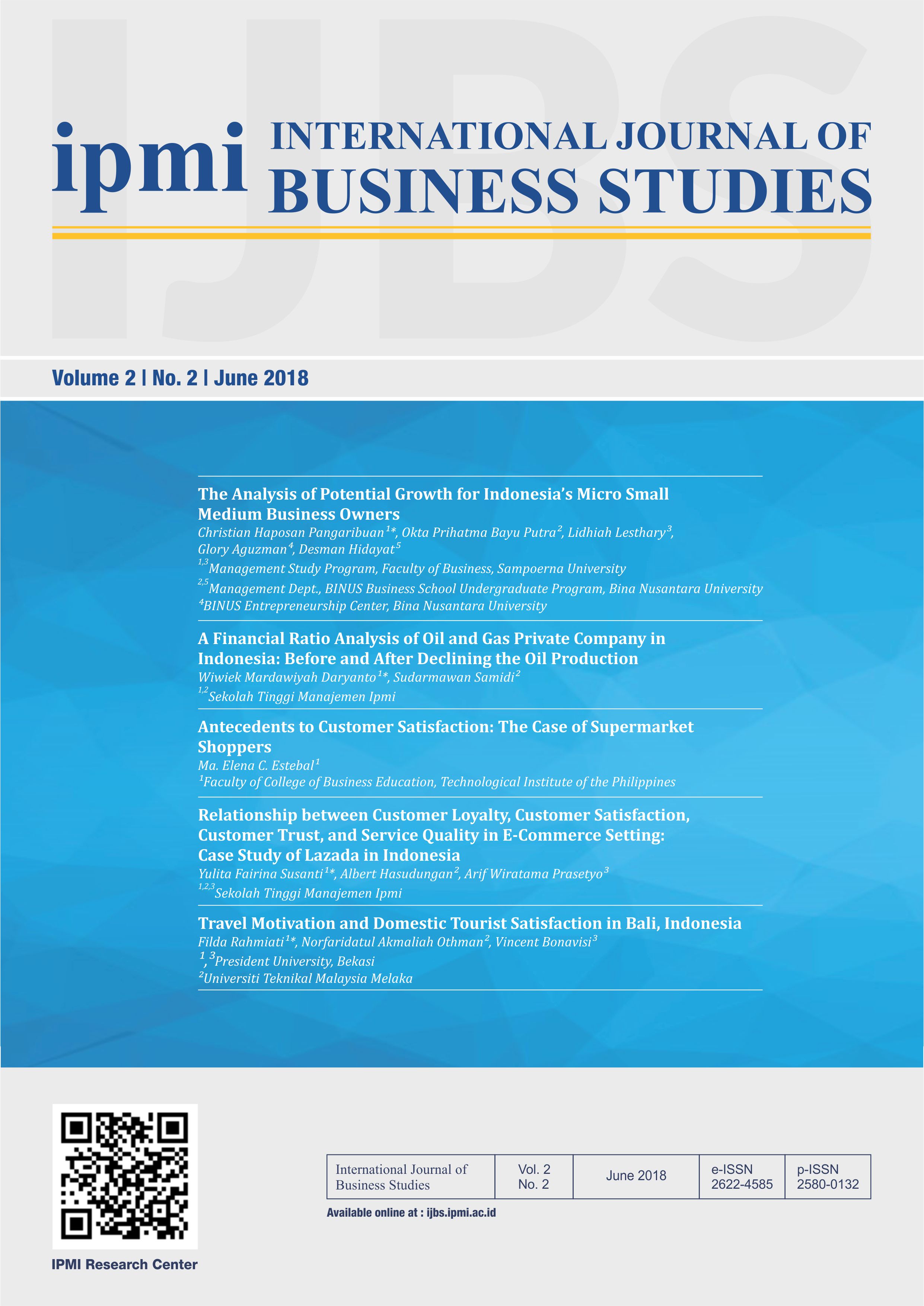
The Analysis of Potential Growth for Indonesia’s Micro Small Medium Business Owners
DOI:
https://doi.org/10.32924/ijbs.v2i2.53Keywords:
Potential Growth, Export Oriented, Micro Small Medium Enterprises, Small Business, EntrepreneursAbstract
This study examines the relation between potential growth in the context of micro, small, medium enterprises by evaluating several factors, i.e. lack of marketing ability, inadequate business training, technological backwardness, poor quality of products, lack of innovation, unfavorable legal and regulatory framework, insuficient capital, and shortage of skilled labor. The data collected is from 196 self-employed enterprises in Jakarta, Indonesia. Results indicate that unfavorable legal and regulatory framework is the most affecting factor to slow down the growth of small businesses as well as a hindrance to its exports opportunities abroad. The further investigation of demographic factors shows how the differences canadd to ourunderstanding in the potential growth of smallbusinesses.
Downloads
Submitted
Published
How to Cite
Issue
Section
License

International Journal of Business Studies by Sekolah Tinggi Manajemen IPMI is licensed under a Creative Commons Attribution-ShareAlike 4.0 International License.
Authors who publish with this journal agree to the following terms:
1. Copyright Transfer Agreement Form can be downloaded HERE.
2. Authors retain copyright and grant the journal right of first publication with the work simultaneously licensed under a CC BY-SA Creative Commons Attribution-ShareAlike 4.0 International License that allows others to share the work with an acknowledgement of the work's authorship and initial publication in this journal.
3. Authors are able to enter into separate, additional contractual arrangements for the non-exclusive distribution of the journal's published version of the work (e.g., post it to an institutional repository or publish it in a book), with an acknowledgement of its initial publication in this journal.
4. Authors are permitted and encouraged to post their work online (e.g., in institutional repositories or on their website) prior to and during the submission process, as it can lead to productive exchanges, as well as earlier and greater citation of published work.

















 This work is licensed under a