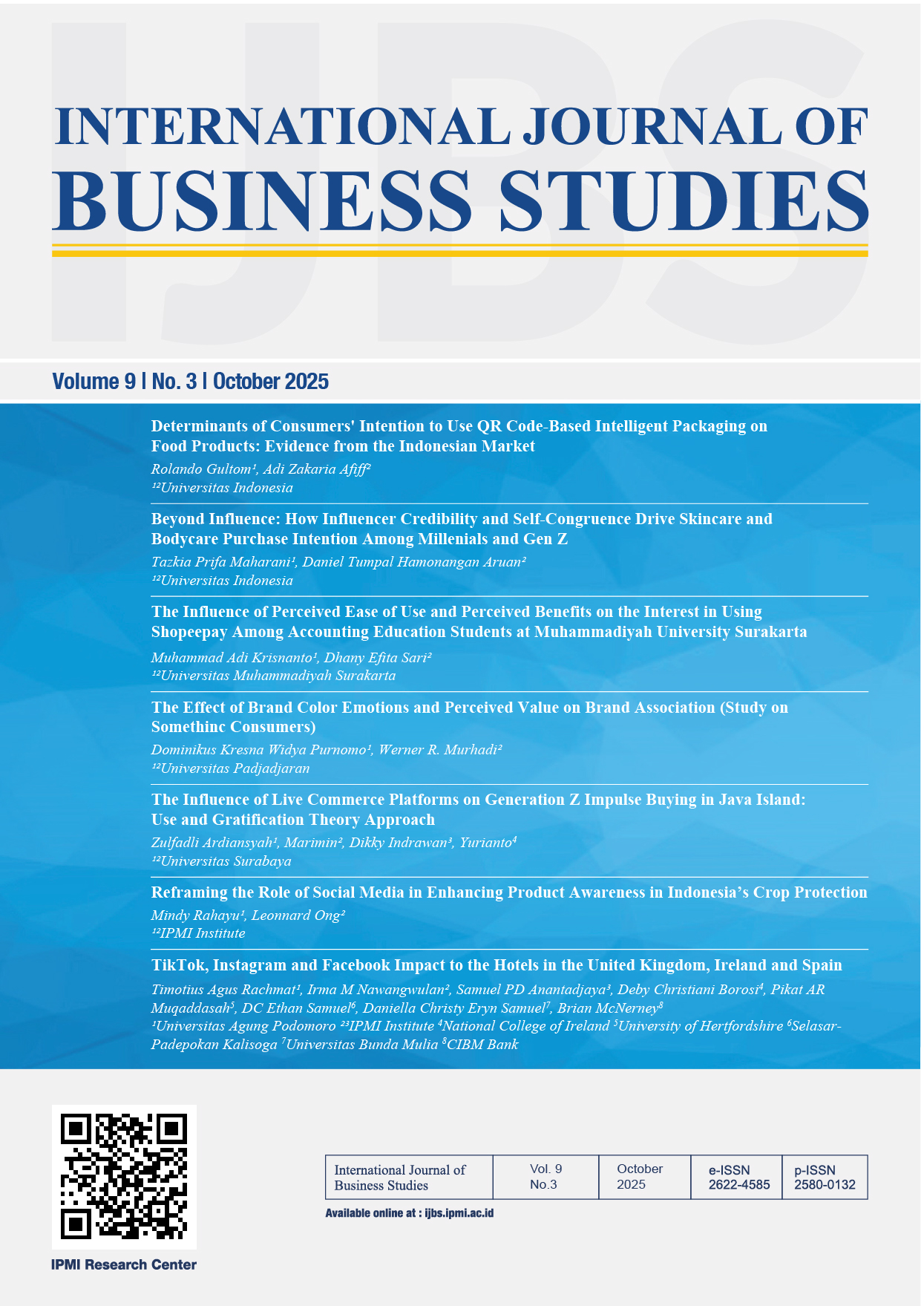
TikTok, Instagram and Facebook Impact to the Hotels in the United Kingdom, Ireland and Spain
DOI:
https://doi.org/10.32924/ijbs.v9i3.407Keywords:
Hotel selection, Zennial, Theory of Planned Behavior, Hospitality Marketing, TikTok, Facebook, InstagramAbstract
This study examines the influence of 3 major social media platforms—TikTok, Instagram, and Facebook—on hotel selection among Zennial travelers (Millennials and Gen Z) across the UK, Ireland, and Spain. As tourism in these regions becomes increasingly shaped by digital engagement, social media has evolved into a central driver of travel inspiration, evaluation, and booking behavior.
Using the Theory of Planned Behavior (TPB), this study explores how attitudes (shaped by visual appeal and influencer credibility), subjective norms (driven by peer interactions, likes, shares, and group discussions), and perceived behavioral control (influenced by accessible booking links, price transparency, and informational clarity) contribute to travelers’ booking intentions. The findings reveal that TikTok primarily drives initial desire and discovery, Instagram strengthens emotional connection and expectation-setting, and Facebook provides informational security that supports final booking decisions. Collectively, these platforms form an interconnected digital pathway that guides travelers from inspiration to confirmation across the UK, Ireland, and Spain. The research underscores the need for hospitality marketers to adopt cross-platform strategies that integrate authenticity, visual storytelling, and community-based trust to effectively influence the modern travel consumer.
Downloads
Submitted
Accepted
Published
How to Cite
Issue
Section
License
Copyright (c) 2025 Timotius A Racmat, Irma M Nawangwulan, Samuel PD Anantadjaya, Deby C Borosi, Pikat AR Muqaddasah, DC Ethan Samuel, Daniella CE Samuel, Brian McNerney

This work is licensed under a Creative Commons Attribution 4.0 International License.

International Journal of Business Studies by Sekolah Tinggi Manajemen IPMI is licensed under a Creative Commons Attribution-ShareAlike 4.0 International License.
Authors who publish with this journal agree to the following terms:
1. Copyright Transfer Agreement Form can be downloaded HERE.
2. Authors retain copyright and grant the journal right of first publication with the work simultaneously licensed under a CC BY-SA Creative Commons Attribution-ShareAlike 4.0 International License that allows others to share the work with an acknowledgement of the work's authorship and initial publication in this journal.
3. Authors are able to enter into separate, additional contractual arrangements for the non-exclusive distribution of the journal's published version of the work (e.g., post it to an institutional repository or publish it in a book), with an acknowledgement of its initial publication in this journal.
4. Authors are permitted and encouraged to post their work online (e.g., in institutional repositories or on their website) prior to and during the submission process, as it can lead to productive exchanges, as well as earlier and greater citation of published work.







 This work is licensed under a