Determinants of Consumers' Intention to Use QR Code-Based Intelligent Packaging on Food Products: Evidence from the Indonesian Market
DOI:
https://doi.org/10.32924/ijbs.v9i3.395Abstract
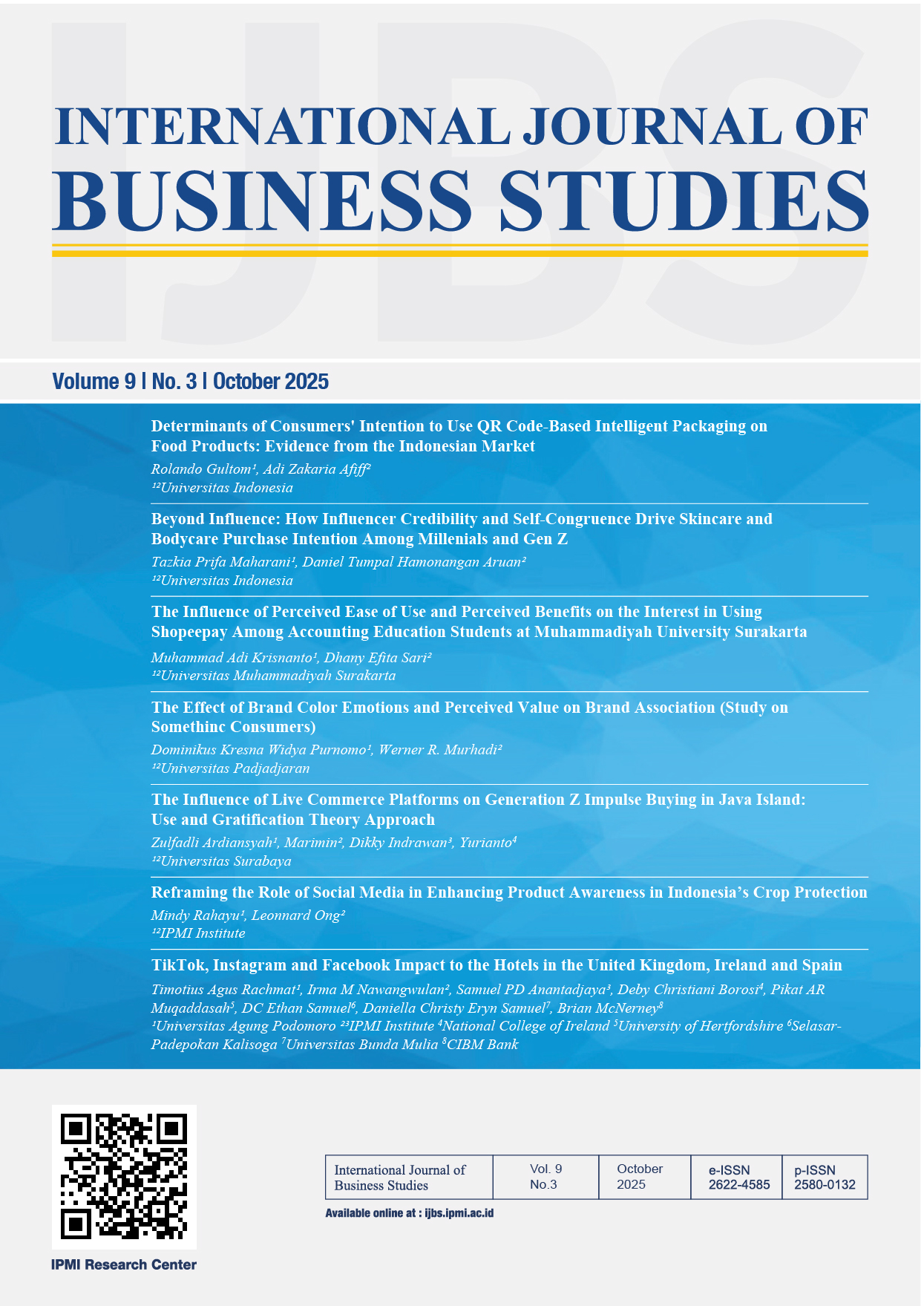
This study examines the factors influencing consumers’ intention to use intelligent packaging based on QR Code technology for product authenticity verification in the Indonesian food sector, using the Value-based Adoption Model (VAM). The proposed model integrates seven core constructs: perceived usefulness, perceived enjoyment, perceived informativeness, perceived technicality, perceived fee, perceived privacy risk, and perceived value as a key mediating variable influencing intention to use. Data were collected from 263 respondents through an online questionnaire, with 249 valid responses analyzed using Partial Least Squares-Structural Equation Modeling (PLS-SEM). The study supports five out of seven hypotheses, with perceived informativeness having the strongest indirect effect on adoption intention through perceived value. Perceived technicality and usefulness also positively influenced value, while perceived enjoyment and privacy risk were not supported by the data. A slight price increase negatively affected perceived value. Overall, perceived value mediated the relationship between technology benefits, costs, and adoption intention. The study extends the VAM framework in intelligent packaging and suggests directions for future research.
Downloads
Submitted
Accepted
Published
How to Cite
Issue
Section
License
Copyright (c) 2025 Rolando Gultom, Adi Zakaria Afiff

This work is licensed under a Creative Commons Attribution 4.0 International License.

International Journal of Business Studies by Sekolah Tinggi Manajemen IPMI is licensed under a Creative Commons Attribution-ShareAlike 4.0 International License.
Authors who publish with this journal agree to the following terms:
1. Copyright Transfer Agreement Form can be downloaded HERE.
2. Authors retain copyright and grant the journal right of first publication with the work simultaneously licensed under a CC BY-SA Creative Commons Attribution-ShareAlike 4.0 International License that allows others to share the work with an acknowledgement of the work's authorship and initial publication in this journal.
3. Authors are able to enter into separate, additional contractual arrangements for the non-exclusive distribution of the journal's published version of the work (e.g., post it to an institutional repository or publish it in a book), with an acknowledgement of its initial publication in this journal.
4. Authors are permitted and encouraged to post their work online (e.g., in institutional repositories or on their website) prior to and during the submission process, as it can lead to productive exchanges, as well as earlier and greater citation of published work.

















 This work is licensed under a