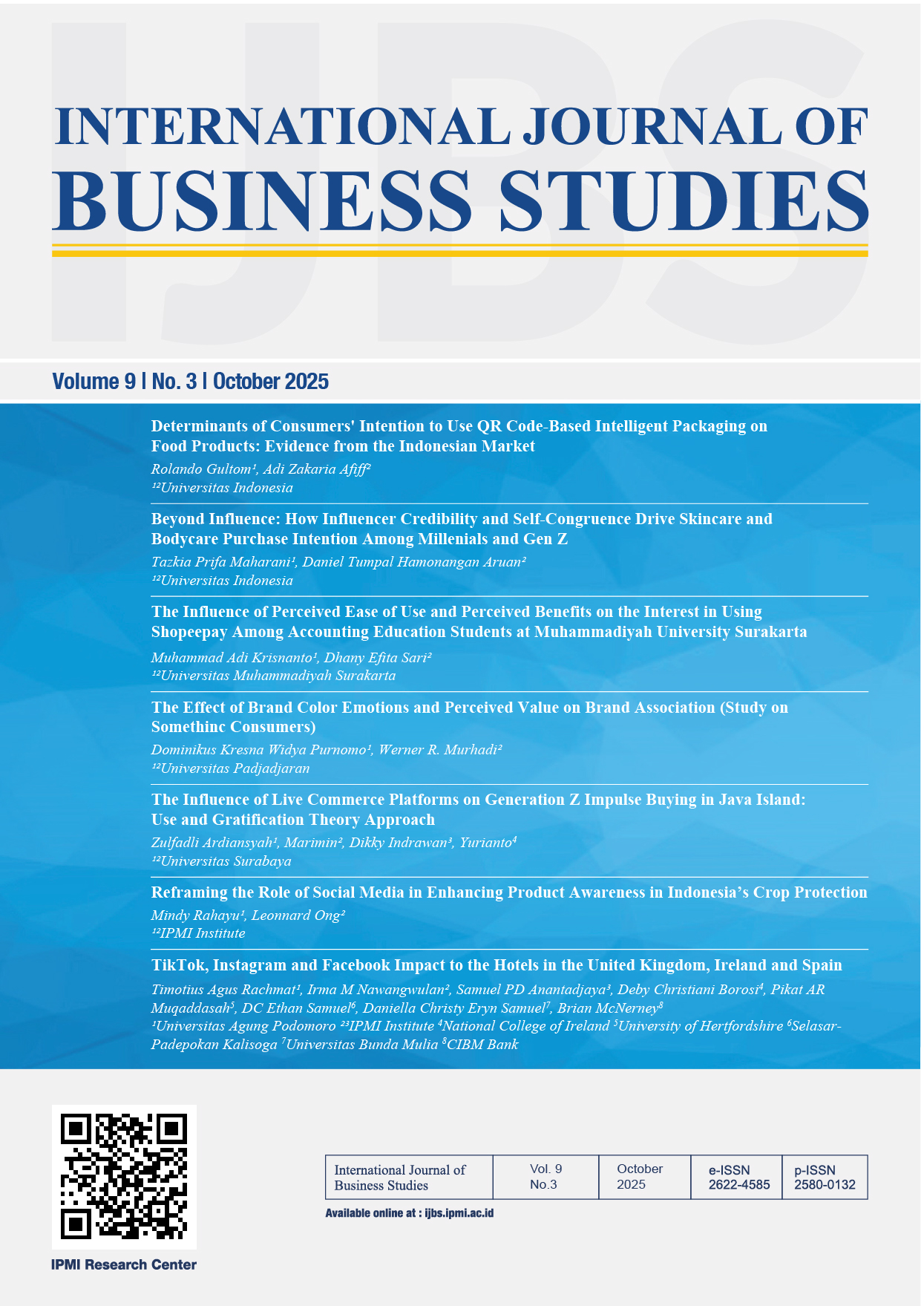
Beyond Influence: How Influencer Credibility and Self-Congruence Drive Skincare and Bodycare Purchase Intention Among Millenials and Gen Z
DOI:
https://doi.org/10.32924/ijbs.v9i3.384Abstract
In today's digital age, beauty influencers play a big role in shaping how people choose skincare and bodycare products. This study looks at how two factors source credibility (how trustworthy an influencer seems) and self-influencer congruence (how similar the influencer feels to the consumer) affect the purchase intentions of Millennials and Gen Z in Indonesia. The research also explores whether parasocial relationships (feelings of closeness with an influencer) and trust help explain this influence. Using survey data from 360 social media users who follow beauty influencers, the study applied statistical analysis (PLS-SEM) to test these relationships. Results show that both credibility and similarity significantly impact purchase intentions—both directly and through trust and parasocial bonds. These psychological connections are key in turning influencer influence into actual buying behavior. This study helps improve our understanding of influencer marketing and gives brands insights on how to create more authentic and effective campaigns by choosing influencers who resonate well with their audience.
Downloads
Submitted
Accepted
Published
How to Cite
Issue
Section
License
Copyright (c) 2025 Tazkia Prifa Maharani, Daniel Tumpal Hamonangan Aruan

This work is licensed under a Creative Commons Attribution 4.0 International License.

International Journal of Business Studies by Sekolah Tinggi Manajemen IPMI is licensed under a Creative Commons Attribution-ShareAlike 4.0 International License.
Authors who publish with this journal agree to the following terms:
1. Copyright Transfer Agreement Form can be downloaded HERE.
2. Authors retain copyright and grant the journal right of first publication with the work simultaneously licensed under a CC BY-SA Creative Commons Attribution-ShareAlike 4.0 International License that allows others to share the work with an acknowledgement of the work's authorship and initial publication in this journal.
3. Authors are able to enter into separate, additional contractual arrangements for the non-exclusive distribution of the journal's published version of the work (e.g., post it to an institutional repository or publish it in a book), with an acknowledgement of its initial publication in this journal.
4. Authors are permitted and encouraged to post their work online (e.g., in institutional repositories or on their website) prior to and during the submission process, as it can lead to productive exchanges, as well as earlier and greater citation of published work.

















 This work is licensed under a