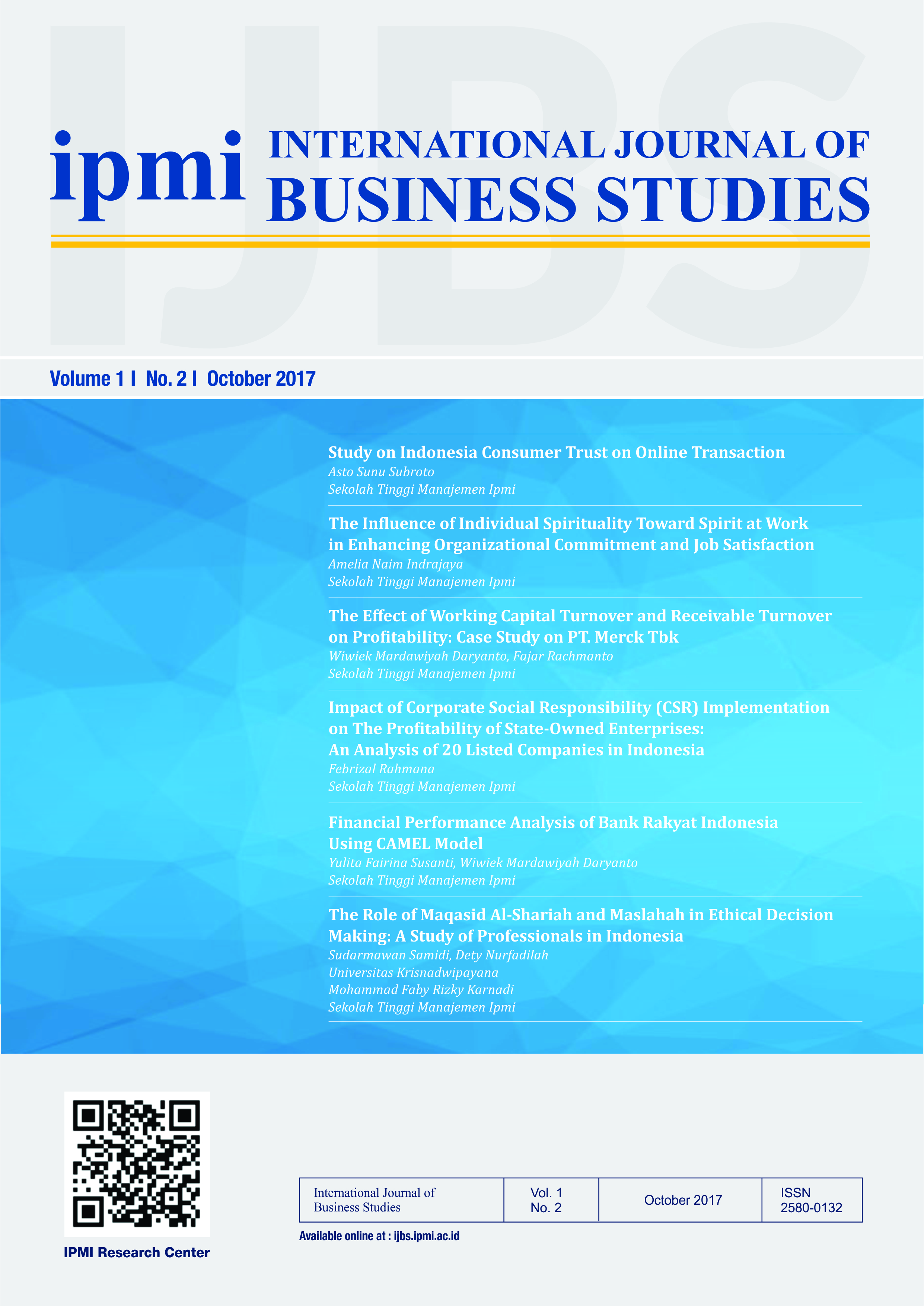
The Effect of Working Capital Turnover and Receivable Turnover on Profitability: Case Study on PT. Merck Tbk
DOI:
https://doi.org/10.32924/ijbs.v1i2.20Keywords:
Working capital, Account receivable, Turnover, ProitabilityAbstract
With the growing world ofbusiness, the competition between similar companies getting tighter. To maintain the viability of a company required a good management of resources conducted by the management. Account Receivable turnover and working capital are very important for a company because it is the elements in measuring the proitability of the company. The purpose of this research is to know: (1) the effect of account receivable turnover to company proitability, (2) the effect ofworking capital turnover to the company, (3) the effect of account receivable turnover and working capital turnover to company proitability. The research method used is quantitative analysis, correlation coeficient test, the coeficient of determination test and hypothesis test. The data used in this study is secondary data sourced from inancial statement PT. Merck Tbk period 2009-2013 obtained directly from the respondent. The results based on multiple linear regression tests showed that simultaneously turnover of account receivable and working capital turnover did not
signiicantly affect company proitability (5.603 < 9.55). Partially, the account receivable turnover does not signiicantly affect the proitability of the company (2.298 < 3.182) and the working capital turnover does not signiicantly affect the proitability of the company (3.003 < 3.182). So, it can be said the hypothesis in this study was rejected.
Downloads
Submitted
Published
How to Cite
Issue
Section
License

International Journal of Business Studies by Sekolah Tinggi Manajemen IPMI is licensed under a Creative Commons Attribution-ShareAlike 4.0 International License.
Authors who publish with this journal agree to the following terms:
1. Copyright Transfer Agreement Form can be downloaded HERE.
2. Authors retain copyright and grant the journal right of first publication with the work simultaneously licensed under a CC BY-SA Creative Commons Attribution-ShareAlike 4.0 International License that allows others to share the work with an acknowledgement of the work's authorship and initial publication in this journal.
3. Authors are able to enter into separate, additional contractual arrangements for the non-exclusive distribution of the journal's published version of the work (e.g., post it to an institutional repository or publish it in a book), with an acknowledgement of its initial publication in this journal.
4. Authors are permitted and encouraged to post their work online (e.g., in institutional repositories or on their website) prior to and during the submission process, as it can lead to productive exchanges, as well as earlier and greater citation of published work.

















 This work is licensed under a