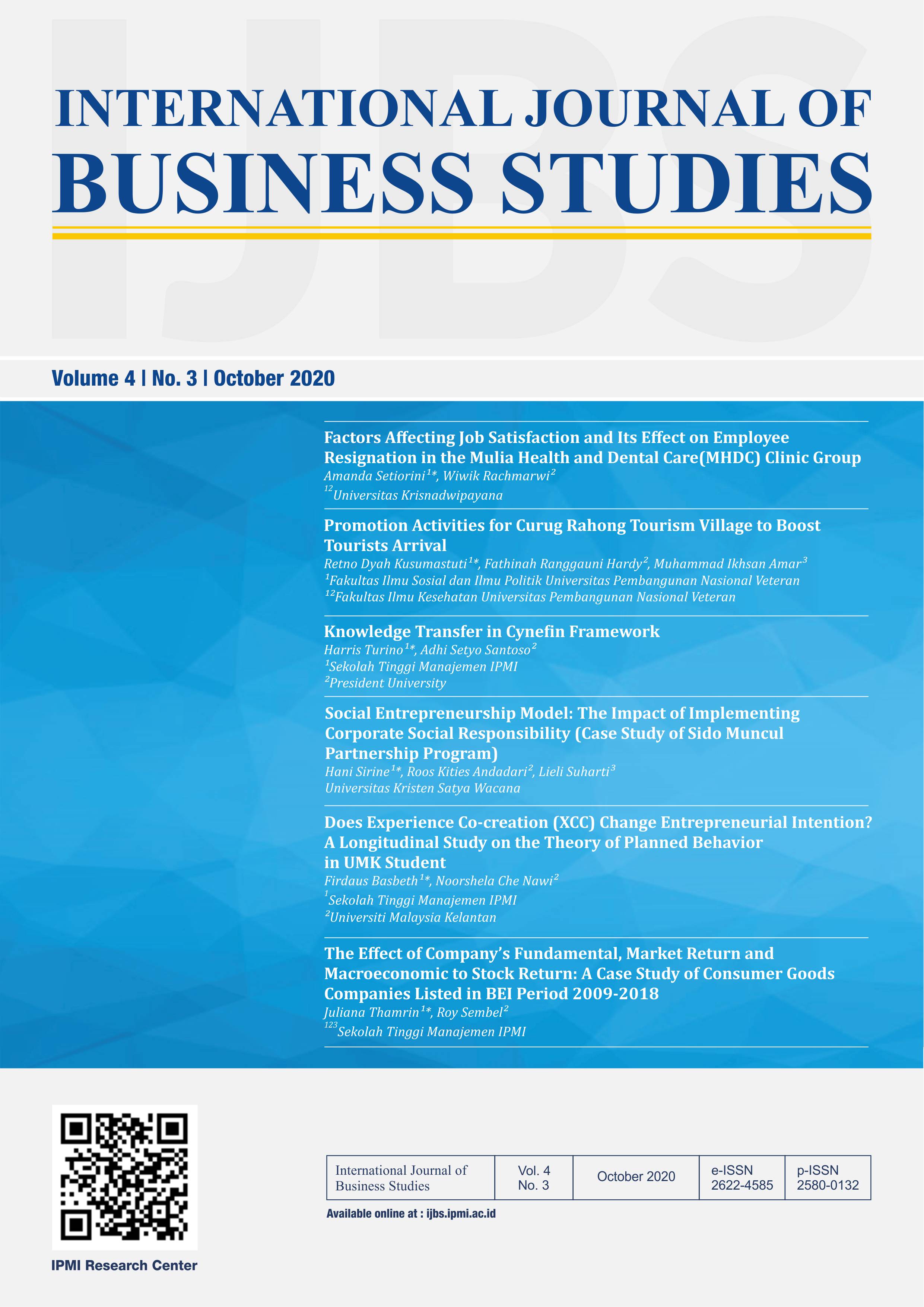
Knowledge Transfer in Cynefin Framework
DOI:
https://doi.org/10.32924/ijbs.v4i3.162Keywords:
Cynefin Model, Knowledge Transfer, Absorptive Capacity, Pragmatic View of Knowledge, Causal Ambiguity, Knowledge Management, Sustainable Competitive AdvantageAbstract
The Cynefin model (Kurtz & Snowden, 2003) is a common concept for designing the most logical response from decision-makers in certain situations. This model is general, so it can be used in several applications, such as knowledge transfer, which is the focus of this article. The author aims to describe in detail, both the characteristics of the domain and the decision-making model, with the concept of causal ambiguity (Reed & Defillippi, 1990), absorptive capacity (Zahra & George, 2002), and pragmatic view of knowledge (Carlile, 2004). One of the managers' common mistakes in managing organizational knowledge is the failure to identify situations accurately. Using the case study method, the results of this study are expected to help practitioners minimize these mistakes and determine the right decisions in forming a sustainable competitive advantage (SCA). The discussion of this paper is divided into several sections; dynamics of cynefin model, absorptive capacity, pragmatic view of knowledge, integration of concepts, and conclusions.
Downloads
Submitted
Accepted
Published
How to Cite
Issue
Section
License

International Journal of Business Studies by Sekolah Tinggi Manajemen IPMI is licensed under a Creative Commons Attribution-ShareAlike 4.0 International License.
Authors who publish with this journal agree to the following terms:
1. Copyright Transfer Agreement Form can be downloaded HERE.
2. Authors retain copyright and grant the journal right of first publication with the work simultaneously licensed under a CC BY-SA Creative Commons Attribution-ShareAlike 4.0 International License that allows others to share the work with an acknowledgement of the work's authorship and initial publication in this journal.
3. Authors are able to enter into separate, additional contractual arrangements for the non-exclusive distribution of the journal's published version of the work (e.g., post it to an institutional repository or publish it in a book), with an acknowledgement of its initial publication in this journal.
4. Authors are permitted and encouraged to post their work online (e.g., in institutional repositories or on their website) prior to and during the submission process, as it can lead to productive exchanges, as well as earlier and greater citation of published work.

















 This work is licensed under a